
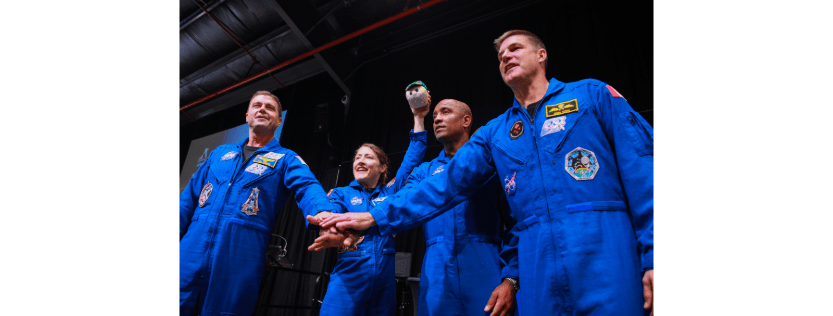

History-making Artemis II crew makes ‘tour stop’ at Marshall Space Flight Center
After an out of this world reception from a sellout crowd Monday night at Toyota Field, the Artemis II crew landed Tuesday at the Marshall Space Flight Center.
Commander Reid Wiseman, Pilot Victor Glover, and Mission Specialists Christina Koch and Jeremy Hansen spoke to and answered questions from MSFC employees who did the work to build the spacecraft, launch the mission and bring the crew home.
“We are thrilled to be back here with our family. This is our trust turned to gratitude to congratulations tour,” Koch said during a news conference Tuesday.
“Being here as a team,” Hansen said. “It was important to be here and thank this unsung team.
“The incredible challenges this team faced is an example of humanity working together to meet challenges.”
The mission was NASA’s first crewed flight toward the moon since the final Apollo mission in 1972.
The historic lunar mission also had more firsts in travelling around the moon: Glover was the first person of color, Koch was the first woman, Hansen of the Canadian Space Agency was the first non-U.S. astronaut and Wiseman was the oldest person.
And, during their lunar flyby in April, the crew broke Apollo 13’s record of 248,655 miles for the greatest human distance from Earth, reaching a maximum distance of 252,756 miles.
The visit to Marshall was a sort of homecoming for Koch. A native of North Carolina, she attended Space Camp five times, from 1992 through 1996 (ages 13-17).
“It was an honor to be associated with a place that allowed my dreams to grow,” she said.
During the mission, the crew tested all of its life-support, navigation, and other systems in deep space to make sure everything works properly in preparation for future missions.
“Right off the launch, we began testing,” Wiseman said. “Victor did hand-flying the craft. We intentionally degraded to see if we can fly manually.”
They ventured beyond the far side of the moon as part of a lunar flyby, seeing a side of the lunar surface never seen by humans.
“There’s something so profound to see an unfamiliar ‘face’,” Koch said. “It’s not a picture painted on the sky.”
After travelling for nearly 10 days, Orion splashed down in the Pacific Ocean off the coast of San Diego.
While millions of people watched anxiously as the craft bobbed in the ocean and the retrieval teams headed their way, the crew said they were enjoying themselves.
“We were having a good time,” Glover said. “We had water, Christina had M&Ms … we were pumped.
“It did not seem like that long to us.”
When the tour ends for the crew, they still have some work to do for the upcoming Artemis missions.
“We want to be there as references for them,” Wiseman said. “We underestimate the pride we’ll have when Artemis 4, 5, and 6 are on the moon.
“This is a very special thing we’ve done.”