

How Huntsville small businesses can partner with NASA to land humans on the moon in 2028
In 2027, NASA plans to send four astronauts aboard its Orion spacecraft on a 14-day mission in low Earth orbit to test systems needed to return humans to the Moon.
The Artemis III mission will lay the groundwork for Artemis IV, which targets a lunar landing in early 2028, the first since Apollo 17 in 1972. Beyond returning astronauts to the surface, NASA is pursuing a phased plan to establish a moon base and sustain a long-term human presence.
The agency’s ambitions also extend to Mars. NASA plans to launch Space Reactor-1 (SR-1) Freedom before the end of 2028 to demonstrate nuclear electric propulsion in deep space. The spacecraft will carry a payload of helicopters to explore the Red Planet.
As NASA advances these missions, small businesses can contribute the technology, products, and services needed to support them.
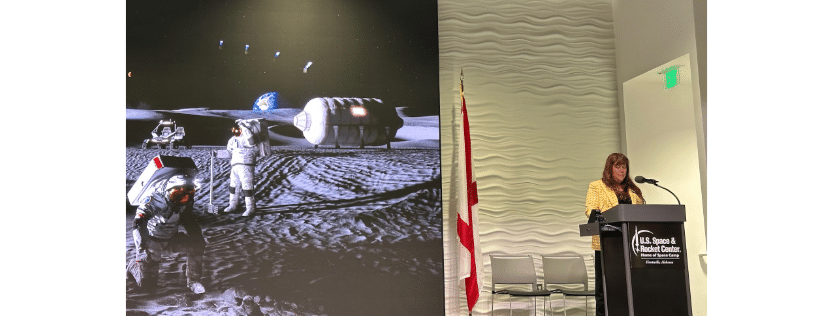
To help companies navigate the agency’s contracting process, The Catalyst Center for Business & Entrepreneurship and NASA Marshall’s Office of Small Business Programs hosted Launchpad: Navigating Small Business Opportunities with NASA Marshall Space Flight Center.
The event was held on Oct. 29 at the U.S. Space & Rocket Center’s Space Camp Operations Center in Huntsville.
NASA Office of Small Business Programs Assistant Administrator Dwight D. Deneal outlined the agency’s priorities and the role entrepreneurs will play in carrying them out.
He emphasized that the return to the moon has implications beyond exploration.
“This is not a photo op moment for us; this is absolutely a serious race,” Deneal said.
He described the competition as a matter of national security with consequences for the United States and its allies.
“We have an adversarial nation with absolute intentions of going back to the moon and conquering it for their own means. And if we don’t beat them there, it could cause serious consequences for not only our nation, but other allied partners,” Deneal said.
NASA Administrator Jared Isaacman outlined the agency’s approach during its March 24 Ignition event.
The priorities include:
- Artemis and the Moon Base: Increase mission cadence and build sustained capability on the lunar surface.
- Low Earth Orbit and Discovery: Support a competitive commercial ecosystem while advancing scientific missions.
- Nuclear Systems and NASA’s Workforce: Advance space nuclear power and propulsion and strengthen technical expertise.
Following Ignition, Isaacman issued 10 directives on May 22 addressing how NASA should organize its personnel, resources, and programs.
Issacman’s 10 Directives:
- Workforce & Organization
- Communications
- Science
- Finance & Infrastructure
- Legislative & Intergovernmental Affairs
- Moon Base
- Nuclear Power & Propulsion
- Low Earth Orbit (LEO)
- Aviation Portfolio
- National Space Policy Execution
Deneal introduced the NASA OSBP SBX App, an updated version of the former OSBP Mobile App designed to help small businesses stay connected to NASA as they pursue contracts with the agency. The tool helps companies find and connect with NASA small business specialists.
For Deneal, building a lunar outpost means finding suppliers across a wide range of disciplines, including manufacturing, energy, and life support.
“Think about everything that we need here to live safely and comfortably here on earth. We’re going to actually need that on the moon,” Deneal.
He stressed that meeting those needs will require contributions from outside the agency.
“You all play a part in that because we just can’t get it done alone. We absolutely need innovators and entrepreneurs to support us in this environment,” Deneal said.
Deneal also noted that FY2026 was a record year for prime contracts in NASA’s history, with $ 4.8 billion obligated to small businesses.
During the event, speakers shared what NASA Prime Contractors look for in partners:
- Technical Capabilities & Innovation
- Quality & Compliance
- Broadening the Industrial Base
- Alignment with NASA Missions
For companies pursuing work through NASA’s prime contractors, panelists emphasized technical expertise, quality, clear communication, and an understanding of the customer’s mission.
Debbie Batson, senior director of business development at Teledyne Brown Engineering, similarly urged attendees to explain how their capabilities address a particular need. She also asked them to allow time for those introductions to reach the appropriate technical staff.
“If it takes a month, just be patient because you’re going to be in front of the right person when you walk in our facility,” Baston said.
During the prime contractors panel, Blue Origin Senior Manager, Supply Chain & Logistics, Lunar Permanence, Libby O’Neal urged companies to highlight their strengths.
“Let us know what makes you different from your competitors,” O’Neal said.
O’Neal emphasized the value smaller suppliers bring to aerospace projects.
“Small businesses are where all the innovation happens,” O’Neal said.
Constance Taddie, ARES Corporation senior director of space and defense, encouraged businesses to maintain relationships and demonstrate their value throughout lengthy procurements.
“Continue to reach out with your government customers, with your small business offices, and then potential teaming partners and attend these industry day events. Share your relevant capabilities and your lessons learned and just look for ways to bring value outside of just a specific opportunity,” Taddie said.
Any local company interested in working with MSFC can get started by visiting NASA’s Office of Small Business Programs. MSFC’s Small Business Specialist, Danielle, can also be contacted at 256-544-1134.