
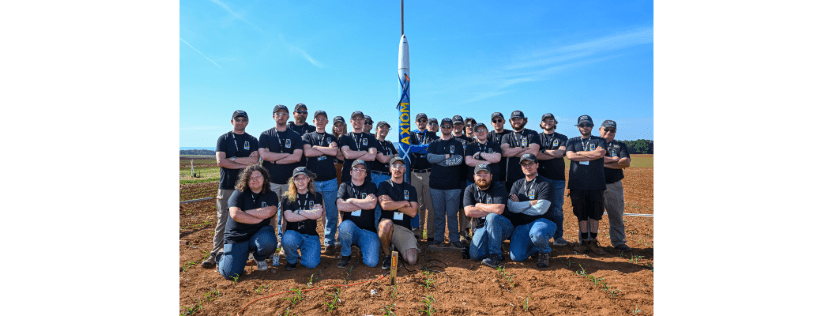

UAH Captures First Place in NASA Student Launch Competition
A team of engineering students from The University of Alabama in Huntsville (UAH) earned first place overall in the NASA 2026 Student Launch Initiative (NSLI), following a nine-month engineering competition that concluded with a final launch event. NASA announced the awards on June 3.
UAH earned first place overall and received a $5,000 prize. Vanderbilt University and North Carolina State University placed second and third, respectively. The UAH team also received the competition’s Social Media Award.
The UAH squad, Charger Rocket Works, achieved top honors among 22 university teams from across the country that advanced to Flight Week, demonstrating excellence in rocket design, systems engineering, testing, documentation, mission execution and technical presentation.
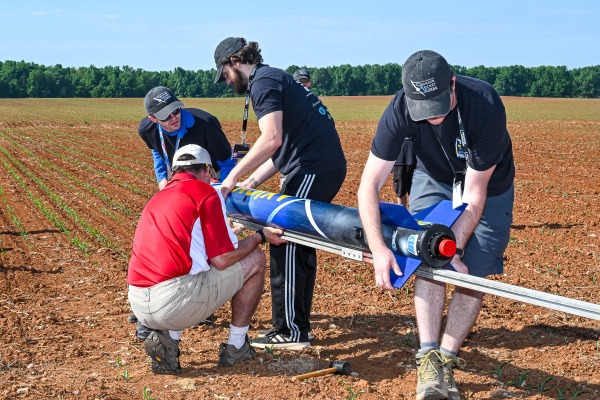
UAH team members prep the Axiom rocket for launch. Credit: Jim Wilkerson
NSLI is one of the Artemis Student Challenges, a rigorous engineering design competition that mirrors the agency’s real-world development process. University teams must successfully complete a series of technical design reviews, conduct multiple flight tests and demonstrate mission readiness before competing in the final launch event. The challenge is designed to provide students with hands-on experience solving complex engineering problems while working alongside NASA and industry professionals.
The UAH team vehicle, Axiom, and payload, EVE (Extraterrestrial Vegetation Evaluator), were designed to meet a demanding mission profile established by NASA. Teams were tasked with achieving a stable subsonic flight to a predetermined altitude between 4,000 and 6,000 feet, safely recover the vehicle and payload and then autonomously collect a 50-milliliter soil sample within 15 minutes of landing to be analyzed for conductivity, pH or nitrate-nitrogen content.
“This year’s team could be summed up in one word: ‘dedicated,’” says Louis McEvoy, program manager for Charger Rocket Works. “The team had a stable launch that reached an altitude of 4,216 feet, followed by a recovery of the vehicle and payload by means of parachute. Upon landing, the payload raised its drill and collected its soil sample, which was subsequently measured for conductivity inside the soil cup, yielding almost no conductivity, consistent with the soil of the region. This information was transmitted live to a ground station that allowed the team to stay in the know on how the payload was performing during drilling operations.”
The successful flight capped months of testing and refinement. The team conducted three subscale launches and five full-scale launches before the competition, providing critical flight data that informed design improvements and increased system reliability.
For McEvoy, the team’s success reflected its willingness to embrace challenges throughout the year. “When major changes to the payload design needed to happen due to a clarification on the language of the mission guide, the payload team stepped up and redesigned the majority of their Preliminary Design Review design to ensure it complied with the competition’s expectations.”
Outreach and area partners help build career excellence
“The team engaged with local industry and community leaders through design reviews with stakeholders and industry guests who provided feedback on both technical aspects and soft skills to improve the team’s NASA presentations,” notes Dr. David Lineberry, a principal research engineer with the UAH Propulsion Research Center, and the team’s faculty advisor.
“The team worked closely with Amentum and Mission Driven Research (MDR) to provide career development opportunities and conducted educational outreach with local schools in partnership with Amentum,” the advisor says. “Also, support provided by the Alabama Space Grant Consortium, Amentum, Precision Business Technology, Beyond Gravity, Corvid, MDR, National Space Club, Huntsville, Onshape, UAH College of Engineering, Verity Integrated Systems and Women in Defense–Tennessee Valley Chapter was instrumental throughout the project.
Lineberry points out that the team benefited from the support of local rocketry organizations as well, including the Huntsville Area Rocketry Association, the Propel Science Foundation and the Southeast Alabama Rocketry Society which provided launch opportunities for testing and development. “Project execution also relied heavily on purchasing and administrative support from the UAH Department of Mechanical and Aerospace Engineering, particularly Renae James, senior staff assistant, whose work supported not only the rocket team but other senior design teams and departmental operations. The team is deeply grateful for her patience and support throughout the project.”
McEvoy credits the team’s success to the commitment of its students, faculty and mentors. “Many of these schools have senior members on their teams who’ve competed multiple times. UAH team members are different every year since they treat the competition as a senior design project. This means every year the team needs to be taught good engineering design practices, manufacturing, testing, safety, budget capture and management, internal and external communications, etc. With each UAH team starting fresh, the team has to cover a lot of ground at the start of the year and throughout the competition.
“Putting in 8- to 14-hour days (and often nights) into this project was commonplace. The team worked tirelessly to ensure their hardware and documentation met all requirements and built incredible relationships with each other, and our industry sponsors, in the process,” McEvoy concludes. “The team was fueled by how much they wanted to succeed while becoming better engineers in the process.”
Charger Rocket Works Team Members:
Program Manager
Louis McEvoy
Team Members
Yovahnick Bautista – Aerospace Engineering
Brennan Begley – Aerospace Engineering
Wesley Blackwood – Mechanical Engineering
Jonah Carrero – Aerospace Engineering
Colt Correll – Mechanical Engineering
Miranda Daye – Aerospace Engineering
Elena Dishman – Aerospace Engineering
Max Hailer – Aerospace Engineering
William Hamlin – Mechanical Engineering
Nicholas Hawse – Aerospace Engineering
Kyle Hughes – Aerospace Engineering
Lora Johnson – Aerospace Engineering
Brody Kriegermeier – Aerospace Engineering
Ezekiel Kuntz – Mechanical Engineering
Cole Lenhart – Aerospace Engineering
Peyton Lewis – Aerospace Engineering
August Longhurst – Aerospace Engineering
Louis McEvoy – Aerospace Engineering
Mason Mills – Aerospace Engineering
Jaxon Nickolson – Aerospace Engineering
Faith Sweetser – Electrical Engineering
Ethan Williamson – Aerospace Engineering
Faith Wilson – Aerospace Engineering
Faculty Advisor
Dr. David Lineberry
Team Mentor and Flyer of Record
Jason Winningham