
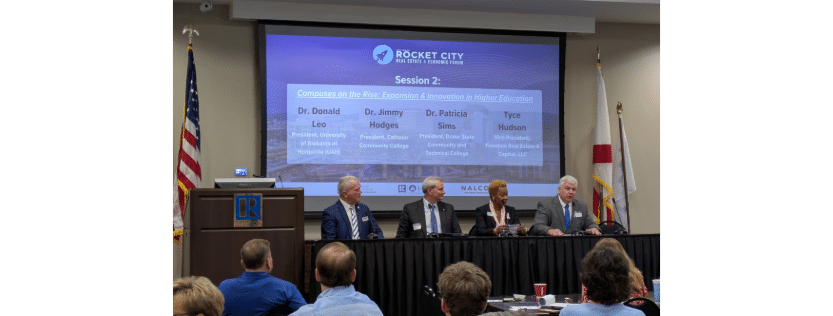

Real estate and economics forum focuses on growth, partnerships
The Alabama Center for Real Estate, part of the University of Alabama’s Culverhouse School of Business, held its eighth annual Rocket City Real Estate and Economics Forum on Thursday.
The event at the Huntsville Area Association of Realtors’ downtown office featured discussions from local industry and higher education leaders, as well as from David Altig, executive vice president and chief economic advisor for the Federal Reserve Bank of Atlanta. Altig opened with an overview of the economic outlook in the United States before the event shifted to a local focus.
Tyce Hudson, vice president of Freedom Real Estate & Capital, LLC, moderated a panel comprising University of Alabama in Huntsville president Donald Leo, Calhoun Community College president Jimmy Hodges and Drake State Community and Technical College president Patricia Sims.
“One thing I’ve been incredibly impressed about this community after being here only four months is how integrated the community is and how supportive the community is of – I’m sure my colleagues would agree – all of the institutions in the area,” said Leo, who became UAH’s president in June.
The college presidents discussed how they’re attempting to meet the demands of today’s and tomorrow’s workforce, and shared campus construction project updates.
“We want to grow. We have to grow, because industry demands it,” Sims said. “The communities look to us to provide the workforce for the growth of the area. You are in this business, so you know that every time I open a newsletter, there are companies that are expanding and growing, or new companies coming along. So it’s really important for us that we are positioned to meet those needs.”
In response to a question about how the local business, real estate and economic development communities can continue supporting the area’s higher education institutions, Hodges said, “If you give our students opportunities at your businesses – co-ops or internships or things like that – that would be beneficial.
“And we don’t know what we don’t know,” he continued. “So if you see a need somewhere in the community that we need to start teaching something or training something different than what we’re doing, let us know that, because we’re open to change.”
The final session of the day focused on aerospace and defense development in the Rocket City. John Roberts, real estate and development manager at Freedom Real Estate & Capital, LLC, moderated a panel discussion with Erin Koshut, executive director of Cummings Research Park; James Lomax, vice president of asset management and leasing at COPT Defense Properties and Alabama state representative; and Dylan Smith, district director for Congressman Dale Strong’s office.
The panelists discussed efforts to continue wooing employers in the aerospace and defense sectors to the Huntsville area, in addition to how facilities and local infrastructure can adapt to support growth and employers’ needs.
“One of the things we’re seeing is companies coming in, and they’re taking some of our existing properties and renovating them, because that’s cheaper than building brand new in this day and age,” Koshut said of the development at Cummings Research Park. “So that’s giving a new life to some of our older properties. And that’s really exciting.”
During the infrastructure discussion, Lomax acknowledged that there are problem spots in the area.
“We do absolutely have some issues that we’ve got to handle,” he said. “For example, if you’ve tried to merge from 565 onto Memorial Parkway going south, that ramp is seven times over capacity based on just the car count.” But, he emphasized, road construction projects require a lot of planning and by nature are not completed quickly.
“Those are some of the things that do happen when your community grows, and that is not a reason to not grow,” Lomax said of traffic congestion. “Just a reminder that road projects take a very long time. Imagine some of our building projects – a lot of you are developers in this room – except you have to drive cars through your project site every day. That’s how it is building a road project. You have to shut down roads or you’ve got to maneuver around those roads and create a path so that you can build to that capacity.”