
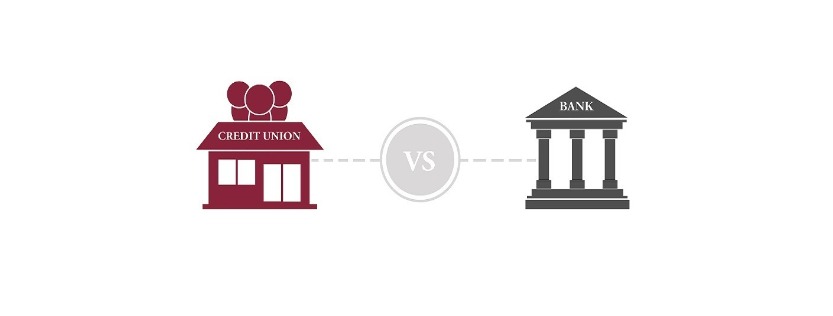

Understanding Key Differences in Banks vs Credit Unions
As a business owner, it’s imperative to have a financial account to manage your business-related income and expenses that is separate from your personal account. Some business owners choose the same institution where they manage their personal finances, but it’s important to explore all options and this includes the various Huntsville city credit unions.
Before you make your decision, it’s important to understand what banks and credit unions offer their customers and how that aligns with your business’s financial goals and circumstances. This resource article aims to lay out some of the key difference’s between credit unions and banks.
The biggest difference between a bank and a credit union is essentially its profit status. Banks are for-profit, either privately owned or publicly traded, while credit unions are nonprofit institutions completely owned by its members. This for-profit vs. not-for-profit contrast is the driving force behind most differences.
A credit union is owned by its members, and is actually set up the same way as a cooperative. Credit unions typically open membership to individuals who share a common bond, such as the industry they are employed with Redstone Federal Credit Union. Credit unions are also generally exempt from various federal taxes, and some credit unions even receive subsidies from the organizations that they are affiliated with.
It is the credit union’s mission to provide its members with the best terms it can afford for their financial products as opposed to a banks mission to make as much money as possible for shareholders. This means members generally get lower rates on loans, pay fewer (and lower) fees and earn higher APYs on savings products than bank customers do.
We’ve included comparisons on national average rates for 10 common loan and deposit products for banks and credit unions. This information comes from the National Credit Union Administration and the data is sourced from S&P Global Market Intelligence.
Advantages of Banks Over Credit Unions
- More financial products and services: Most banks provide services that aren’t found at credit unions such as investment accounts and financial advisory services in addition to standard banking products.
- Physical branches and ATMs: One of the more obvious draws of banks is the convenience of large numbers of physical locations and ATMs. While most banking is done online in 2022, having ease of access to more locations is always beneficial.
Advantages of Credit Unions Over Banks
- Fees and account flexibility: Credit unions will usually have lower costs and more flexibility than banks. This includes more accounts that don’t have monthly maintenance fees attached to them and do not charge money for overdraft protection.
- Better rates on savings accounts and loans: Credit unions offer higher interest rates on savings accounts and lower rates on loans. Higher interest rates on bank accounts help your money grow faster, while lower rates on loans make it cheaper to borrow money.
One difference about credit unions is that they’re not insured by the Federal Deposit Insurance Corporation, or FDIC. However, even though credit unions are not subject to FDIC insurance, National Credit Union Administration (NCUA) insures deposits in most reputable credit union accounts.
Both FDIC and NCUA insurance guarantee up to $250,000 for account holders if the specified institution were to become insolvent.
All federal credit unions and most state credit unions are insured by the NCUA. At the NCUA website, you can see if your credit union is covered, and NCUA-insured credit unions always prominently display their insurance status on signage in their branches.
Consumer Satisfaction Myth?
One common notion about credit unions is that they offer better, more specific customer service. However, some data shows that banks have surpassed credit unions in overall consumer satisfaction.
Credit unions continue to lose ground with consumers, according to the American Customer Satisfaction Index’s most recent finance study. Credit unions have scored behind banks for four straight years. Banks now score higher than credit unions in nearly every service category as rated by U.S. consumers, according to this year’s survey. On the ACSI’s 100-point scale, credit unions now trail banks by three percentage points. Banks’ overall score (78) has remained relatively unchanged over the last four ACSI reports while the credit unions’ score has fallen to 75.
The 2021-2022 study, which was based on more than 13,500 customer interviews, covers banks, credit unions, financial advisers and online investment. According to researchers, rapid membership growth fueled by the pandemic and ongoing industry consolidation could be affecting credit union customers, though the credit union industry’s traditional area of strength in the annual survey—in-person service—has remained consistent.
National banks climbed 1% to an ACSI score of 77, followed by super regional banks, up one percentage point to 76. Citibank places first among national banks after inching up one percentage point to 78. Bank of America rose one percentage point to 77 to meet Chase for second place. Wells Fargo took last place for the sixth consecutive year despite advancing three percentage points to 76. Capital One expanded its lead among super regional banks, surging four percentage points to 81. PNC Bank rose three percentage points to 78, followed by U.S. Bank, which rose three points to 77.
For the fourth year in a row, Forbes recognized Redstone Federal Credit Union as a top credit union in the state after reviewing member surveys and overall standings.
Forbes partnered with market research firm Statista to produce the annual ranking of the Best Credit Unions in Each State for 2022. Banks and Credit Unions were scored in sub-categories including trust, member and branch services, digital services, financial advice, and terms and conditions. Only 2.7% of all banks and 3.4% of all credit unions made its list, according to an announcement from Forbes.








Leave a Reply
Want to join the discussion?Feel free to contribute!