

Huntsville Bet on Live Music—The Gamble Is Paying Off, But By How Much?
Eight years after Huntsville bet that live music could become an economic development tool, a new report says the gamble is paying off.
According to the 2026 Huntsville Music Audit, unveiled Tuesday at Mars Music Hall, the city’s music economy generated an estimated $278.2 million in economic output last year, supported 3,047 jobs, and contributed $162 million in Gross Value Added to the regional economy. The report, prepared by London-based consultancy Sound Diplomacy for the City of Huntsville, estimates the music sector now accounts for 2.8% of the city’s workforce, a dramatic increase from the 982 jobs identified in the firm’s original 2018 study.
“Today, when someone hears Huntsville, Alabama, they’re just as likely to think of world-class performances as they are about rockets and research,” Mayor Tommy Battle said.
The report paints a picture of a city whose music scene has expanded well beyond occasional concerts. Sound Diplomacy identified 215 music-related assets across Huntsville, compared with 163 in 2018, while the number of live music venues and performance spaces grew from 92 to 132. Huntsville now hosts more than 2,200 music events each year, according to the report, and music businesses can now be found across all five City Council districts.
For Music Officer Matt Mandrella, those numbers reflect years of intentional investment.
“The most humbling feedback we hear from touring artists and local artists is that Huntsville doesn’t just show up as fans; we show up as a community,” Mandrella said. “They feel welcome, they feel supported, and increasingly, they feel like this is a place where they could build a life and not just play a show.”
The report traces that growth back to the city’s first music audit in 2018, also prepared by Sound Diplomacy. That study recommended creating a municipal Music Office, investing in live music infrastructure, and positioning music as part of Huntsville’s broader economic development strategy.
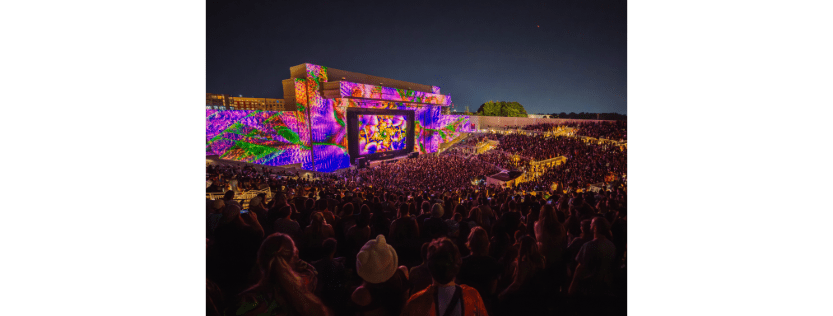
Since then, the city has launched what officials describe as the nation’s first municipal Music Office, opened the $55 million Orion Amphitheater, and partnered with C3 Presents to launch the South Star Music Festival.
Urban and Economic Development Director Shane Davis said city leaders viewed the 2018 report as a framework rather than a one-time planning exercise.
“What we realized through this audit was where we could take Huntsville in a creative way, how we could advance the quality of life, how we could attract the best and the brightest from a workforce standpoint,” Davis said.
Much of the report focuses on The Orion Amphitheater, which it identifies as the city’s largest music investment. Between the venue’s opening in May 2022 and December 2023, Sound Diplomacy estimates Orion generated $85.2 million in economic output, supported 1,023 jobs, and attracted more than 150,000 visitors from outside the region. Those visitors spent an estimated $76.8 million at local hotels, restaurants, retailers, and entertainment businesses.
The report also credits South Star Music Festival with generating $24.1 million in regional economic impact and nearly $218 million in earned media value during its inaugural year, despite severe weather that canceled the festival’s second day.
Mandrella said Huntsville’s reputation is beginning to spread naturally among touring artists and booking agents.
“If agents know their bands are having a great experience, they’re going to intentionally start routing them through here,” he said.
The report includes an important caveat that is easy to overlook amid the headline figures: The Music Audit is not an independent review.
Sound Diplomacy not only conducted the original study but also recommended the investments and now evaluates their impact—akin to a consultant grading their own homework. That doesn’t mean the findings are inaccurate, but it does put the audit in the company of many commissioned economic impact studies often viewed with skepticism by independent economists.
For decades, economists including Robert Baade, Roger Noll, Dennis Coates and Victor Matheson have argued that commissioned economic impact studies frequently overstate economic benefits by measuring gross spending rather than net new spending.
The distinction matters.
Another caveat that should be noted is how comparisons with 2018 are presented throughout the document even while Sound Diplomacy notes the two studies are not directly comparable. The 2026 report used broader business categories, expanded web scraping and more complete mapping techniques than were available eight years ago. According to the firm, the increase shows both genuine growth in Huntsville’s music economy and a more complete accounting of music-related businesses and organizations.
Not every category grew. While live music venues, educational programs, and support organizations expanded, the number of recording studios and rehearsal spaces declined from 11 to 8. The report attributes that change in part to musicians increasingly producing music from home rather than relying on dedicated studio facilities.
If a Huntsville resident buys tickets to a concert at Orion instead of spending that evening at a downtown restaurant, a movie theater or another entertainment venue, that money has largely been redirected within the local economy rather than creating new economic activity. Critics argue the same caution should apply to economic multipliers, including Sound Diplomacy’s estimate that every dollar generated by Huntsville’s music economy creates an additional 48 cents in regional economic activity.
By contrast, one category economists generally view as more reliable is spending by visitors traveling from outside the region. Those dollars represent money entering Huntsville that likely would not have been spent locally otherwise, making the report’s estimate of $76.8 million in non-local visitor spending associated with Orion among its more defensible findings.
The report also leaves several questions unanswered.
While it estimates the music economy supports 3,047 jobs, it does not distinguish between full-time positions and seasonal, part-time or event-based employment. Likewise, the report does not attempt to compare the public investment required to build projects such as the $55 million Orion Amphitheater against the economic returns it estimates. This calculation is often central to independent research evaluating public entertainment investments.
None of those limitations erase what has happened in Huntsville over the past eight years. The city’s concert calendar is fuller, national touring acts make more frequent stops, and venues such as Orion and festivals like South Star have changed Huntsville’s entertainment landscape.
The debate is less about whether Huntsville’s music economy has grown than about precisely how much of that growth can be measured and attributed to public investment.
For city leaders, however, the report represents validation that music has become another tool for attracting companies and workers to Huntsville.
Mandrella, who also serves as chair of the Association of Music Offices, said he hopes Huntsville’s experience encourages other cities to establish similar programs.
“Imagine if every state had five music offices in different cities,” he said. “Potentially, it could shift the whole music economy.”