

UAH-led Alabama Shield 2026 exercise puts drone technology to the test in realistic disaster scenarios
When disaster strikes, every minute matters, and the right information can mean the difference between uncertainty and action.
To meet these challenges, the University of Alabama in Huntsville hosted Alabama Shield 2026, the first exercise of its kind in Alabama. The statewide disaster response exercise was designed to help participants from a wide variety of emergency management organizations strengthen Alabama’s ability to use drone technology to aid during complex emergencies.
Led by the UAH Rotorcraft Systems Engineering & Simulation Center (RSESC) at the UAH Huntsville UAS and Counter-UAS Test Range, the event provided participants with hands-on experience using UAS in realistic disaster-response scenarios, including search and rescue, damage assessment, HAZMAT reconnaissance, infrastructure inspection, mission planning and airspace deconfliction.
“Alabama Shield 2026 was a success, particularly for a first-year exercise,” said Justin Kumor, principal research engineer with the UAH RSESC. “The event brought together a broad mix of partners, including federal agencies, state emergency management organizations, local public safety organizations, first responders, academia, industry partners and UAS subject matter experts.”
The event gave participants an opportunity to move beyond classroom instruction and put UAS capabilities into practice in an environment designed to replicate the operational challenges of a real disaster. Participants logged approximately 20 live flight hours during the exercise, providing opportunities to develop real-world operational skills with unmanned systems.
“What stood out most was how quickly participants moved from instruction to execution,” Kumor said. “The hands-on scenarios reinforced a central value of UAS in disaster response: giving first responders better information before sending personnel into potentially dangerous areas.”
The program was structured as a progression from instruction to increasingly complex field operations.
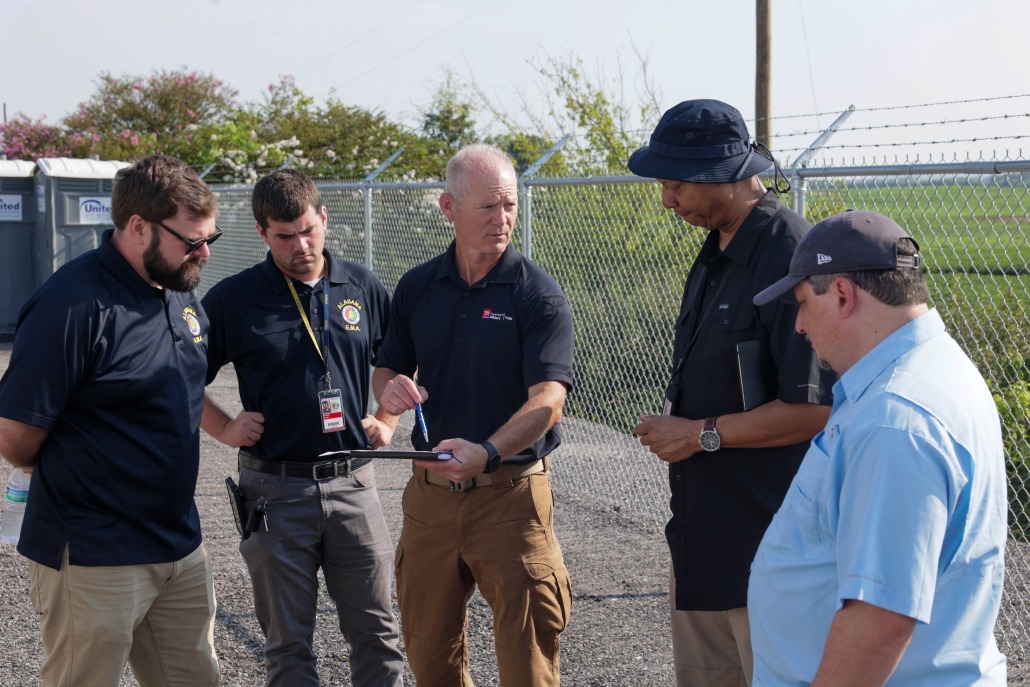
The first day focused on classroom instruction and operational concepts, while on the second day participants worked through hands-on training lanes and platform familiarization. The event culminated with a live exercise in which teams planned missions, operated through an Emergency Operations Center, coordinated with other agencies and responded to changing scenario conditions.
Participants used UAS to address a range of challenges they might encounter during an actual emergency, including a tornado-based disaster scenario.
“In tornado or severe-weather responses, damaged infrastructure, blocked roads, hazardous materials and limited visibility can make it difficult for incident commanders to quickly understand the scope of an emergency,” Kumor said. “UAS can provide a rapid means of assessing conditions and helping officials prioritize personnel and resources.”
The training included search-and-rescue mapping, confined and obstacle-rich flight operations, area assessment, mission planning with a command center, simulated power-line inspection and UAS proficiency tasks.
During the live exercise, teams responded to increasingly complex scenarios involving a missing-person search, a downed aircraft and missing pilot, HAZMAT reconnaissance and an airspace intrusion and deconfliction event.
“Alabama Shield demonstrated that unmanned systems can improve disaster response in three key ways,” Kumor said. “Helping teams locate people, hazards and access routes faster; providing command staff with better information for decision-making; and reducing risk to responders by allowing remote assessment before personnel enter potentially dangerous areas.”
The activities also showed that effective UAS integration is about more than the aircraft itself.
“The biggest lesson is that successful UAS integration is not just about the aircraft; it is about communication, coordination and getting usable information to decision-makers quickly,” Kumor said. “The aircraft performed well, and participants were engaged, but the exercise showed that the real challenge is ensuring the right information reaches the right person at the right time, and in a format they can act on.
“The overall takeaway is that UAS teams need to be integrated into emergency operations from the beginning, not treated as an add-on capability.”
Beyond the technical training, Alabama Shield helped establish relationships among organizations that could be called upon to work together during a future emergency.
“Disasters do not wait for agencies to figure out how to work together,” Kumor said. “Alabama Shield allowed these organizations to build trust, understand each other’s capabilities and identify gaps in a controlled training environment. Just as importantly, the exercise gives UAH a real-world environment to advance its research by testing concepts alongside the emergency management and public safety professionals who would use them during an actual disaster.
“That connection lets UAH move research beyond theory and develop practical tools, procedures and best practices that directly support responders in the field.”
UAH researchers and partners envision the gathering as a recurring exercise that can continue to strengthen disaster preparedness and UAS integration across Alabama and the region.
“Looking ahead, by bringing together the people, technology and expertise needed to respond to disasters, Alabama Shield demonstrates UAH’s role in advancing solutions to real-world challenges while strengthening partnerships across the state,” Kumor said.