
Battle says ‘our economy is strong’ and invites public input on city’s future
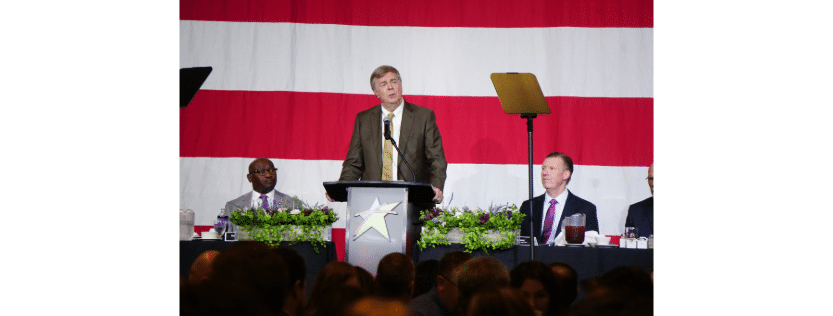
Huntsville mayor Tommy Battle delivered this year’s State of the City address to about 1,200 people gathered in the Saturn Ballroom at the Von Braun Center on Monday afternoon. During the address, which lasted a little more than a half hour, Battle reflected on the city’s population growth, economic development and other changes before encouraging attendees to consider what they want in the Huntsville of the future.
“Look around Huntsville today,” he said. “So much of what you see started with a conversation about […] what you wanted this community to become.”
Battle referenced The Big Picture, the city’s master plan, saying, “The Big Picture worked because people showed up. The Big Picture worked because they shared ideas; they made plans. And they stayed with them. And that’s the real lesson of the last decade. But here’s the thing about building a great city: you never finish.”
The mayor said that over the next year, the planning department will solicit input from Huntsville residents about what they want the city to look like in the future, including what they love about their neighborhoods and what they believe needs attention, in an initiative called The Big Picture Next Generation.
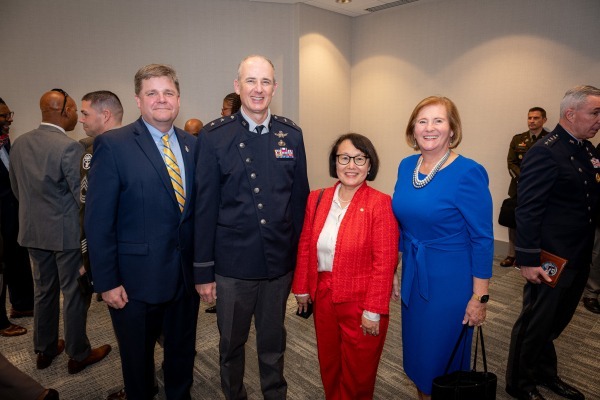
Photo: Huntsville/Madison County Chamber
“What should our roads, parks, housing and public spaces look like 10 or 20 years from now?” Battle asked. “We’re not starting over. We’re building on what we’ve accomplished.”
He added that the Rocket City has gained more than 50,000 new residents since the initial conversations for the first iteration of The Big Picture, and that at 231 square miles, Huntsville is now the 28th largest city in the U.S. in terms of land mass. (Its nearly 254,000 residents make it 94th largest in terms of population, he said.)
“That’s a gift, because it gives us room to plan and make decisions about the future that we want for our community,” he said during Monday’s sold-out luncheon.
Over the past decade, Battle said, Huntsville’s housing supply has increased by more than 30,000 – 32% – alongside its 26% population growth. Also since 2016, economic development across the greater metro area has created more than 71,000 jobs and nearly $17 billion in industrial development, he said. He added that the average household income in Huntsville is about $115,000.
“Metro employment is approaching 300,000 and growing by 3.5% each year,” Battle said. “This is twice the growth rate of the U.S. and accounts for 26% of Alabama’s job growth.”
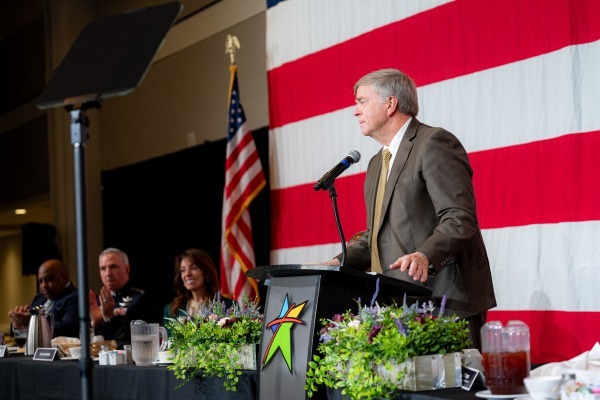
Photo: Huntsville/Madison County Chamber
The North Alabama region’s cost of living is still about 10% lower than the national average, he added, and housing costs are about 30% lower than the national average. The city of Huntsville itself also has the highest possible credit ratings from Moody’s and Standard & Poor’s – Aaa and AAA, respectively.
Battle highlighted noteworthy projects and changes the city has seen in recent months. He pointed out that Redstone Arsenal is one of the area’s biggest employment hubs, and welcomed the U.S. Space Command to the campus that’s also home to the Army Materiel Command and Missile Defense Agency, an FBI cyber training facility and NASA’s Marshall Space Flight Center.
He mentioned Eli Lilly’s proposed $6 billion pharmaceutical manufacturing facility in Huntsville – the largest single private investment in the state – and said that the one millionth car at the local Mazda Toyota Manufacturing plant rolled off the assembly line in October of this year.
Battle also brought attention to the city’s efforts with local partners to create affordable housing.
“This year, working through community partnerships, we’ve opened 128 affordable apartments for seniors, with another 143 multi-family units under construction,” he said. “One of our most important efforts is Mill Creek. We’re partnering with Huntsville Housing Authority and Huntsville Hospital to transform an aging public housing area near downtown into a connected, mixed-income neighborhood.” Mill Creek plans call for a mix of more than 700 affordable, workforce and market-rate homes, plus green space, he added.
The mayor also highlighted retail growth, road improvement projects, and the city’s sports and entertainment venues.
“What is the state of our city?” Battle asked in conclusion. “Our economy is strong, our opportunities are growing, our challenges are real, but our future is ours to shape.”