
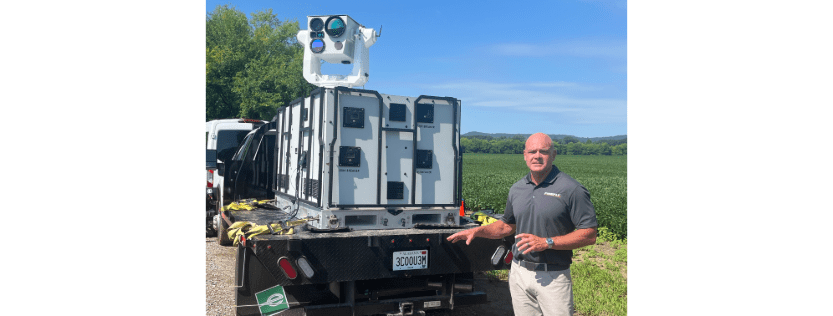

KBR’s Firefly anti-drone system conducts warfare with high energy
In a matter of seconds and a puff of smoke, the threat is eliminated.
And in this era of drones and counter-drones, this is what warfare has become.
KBR is on the front-line of this new style of combat with its Firefly weapon system – designed, engineered and tested in Huntsville.
Simply put, it is a compact, palletized laser weapon system that can shoot down drones or other unmanned aircraft threats from the back of a truck or a flat bed.
KBR, which has about 1,000 employees in Huntsville, showcased the system Thursday with a live demonstration of the directed energy system that uses focused laser energy to detect, track and defeat drone threats.
“We specialize in directed energy,” said Senior Director David Zollar. “KBR has been doing direct energy for more than a decade. This isn’t something new for us.”
Laser systems like Firefly are emerging as a critical layer of modern air defense, as drones become cheaper, more common and easier to exploit.
“The drone threat is real,” he said while citing that some 1,600 drones were detected around venues at the World Cup and 750 were confiscated. “Drones are becoming increasingly available and relatively inexpensive.
“As the threat evolves, we’ve got to do the same thing.”
Firefly provides flexible protection for military bases, convoys, airports, outdoor venues, VIP protection and more.
Designed to counter low-cost unmanned aerial systems and drones, the mobile 5 kW to 40 kW system detects threats and neutralizes them within seconds.
A key to neutralizing the threat is the mobility of the system.
“It can be in place and operational in 30 minutes,” said Jon Shepard, director of the Directed Energy Technology Programs. “The laser can track to five miles and attack at one mile.
“It takes about 2 to 5 seconds to neutralize the threat.”
System capabilities:
- Power Range: Scalable high-energy laser architecture from 5 kW to 40 kW.
- Engagement Range: Detects small drones up to 5 miles away and engages at roughly 1.5 miles.
- Target Neutralization: Destroys or disables targets within 2 to 5 seconds of engagement.
- Design: Modular, self-contained, and palletized for easy transport on tactical vehicles or flatbed trucks.
- Integration: Interfaces seamlessly with military radar and command-and-control architectures like Sentinel Radar and FAAD.
The battery-powered directed energy system hooks up to a radar to track the threat. There are 15 hours of power in the batteries that can be recharged with standard, off-the-shelf generators.
And, in this digital age, modern soldiers with X-box experience feel right at home with the controls.
“Our soldiers pick this up relatively easily,” Shepard said. “One soldier went into operation in five minutes.
“Everything is focused for the operator in the field.”
KBR awarded $208 million Army contract
In other KBR news, the company announced Trinzic, the planned spin-off of its Mission Technology Solutions business, has secured an estimated $208 million cost-plus-fixed-fee task order.
The contract is to continue supporting the Army’s Tactical Aviation and Ground Munitions portfolio, a centerpiece of the Army’s precision strike and aviation modernization efforts.
The five-year recompete extends KBR’s role as a prime contractor on one of the Army’s highest lethality priorities, and it reinforces the company’s long-standing leadership in defense technology modernization for the U.S. and its allies.
Trinzic is expected to go public in January.
“This award reflects the Army’s trust in KBR to move quickly and handle complexity without losing focus on the mission,” said Jay Lennon, president of Mission Technology Solutions. “For more than 25 years, KBR has helped take the Army’s most important precision weapons from concept to combat readiness, shortening development timelines and accelerating delivery to the field.”
The award directly supports the Army’s top modernization priorities, including multi‑domain operations, Army Aviation lethality, and Launched Effects and low-cost, effective Counter-Unmanned Aircraft System capabilities.