
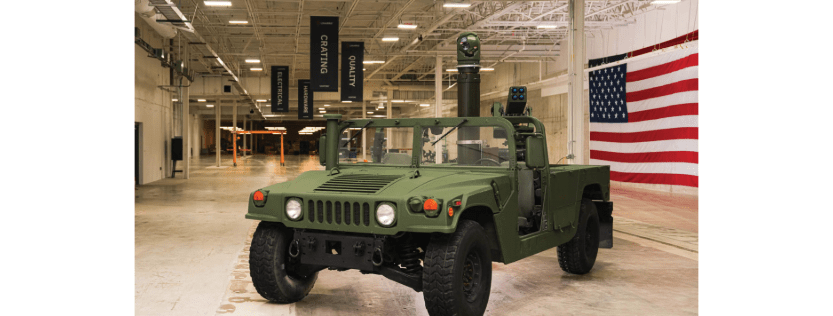

Bite of the VAMPIRE: L3Harris ramps up counter-drone production in Huntsville
There will soon be VAMPIREs flying out of Cummings Research Park.
And they will be deadly.
No, we’re not talking about the likes of Dracula or Nosferatu nor, even, characters of Anne Rice.
These VAMPIREs (Vehicle-Agnostic Modular Palletized ISR Rocket Equipment) are the latest line of defense against drone attacks and L3Harris is ramping up its production here.
The company, which has a new facility in Cummings Research Park, made the announcement Tuesday at the AUSA Global Force Symposium & Exhibition in the Von Braun Center.
“We’re making every effort to put these effective, combat-proven systems on the frontline as fast as possible to save lives,” said Tom Kirkland, L3Harris president, Targeting and Sensor Systems, Communications & Spectrum Dominance, L3Harris. “Our newest production line combines the best people, technology, facilities and innovation to deliver the ultimate C-UxS solution to our customers.”
The 379,000 square-foot facility features a flexible assembly, testing and installation area to integrate VAMPIRE onto ground vehicles and containerized weapon systems. The production line can adjust and increase volume as demand evolves.
“The most exciting thing is opening the new facility,” Kirkland said. “Starting with a core team of manufacturing, engineers, logistics, assembly. There’s a ton of talent here.”
The VAMPIRE system has detected, tracked and defeated small drones during combat operations in Ukraine since 2023.
In 2025, L3Harris announced it was expanding the system to include specialized variants for land, maritime, air and electronic warfare operations, as well as the integration of VAMPIRE aboard new defense ground vehicles.
Kirkland said the company will be building its entire VAMPIRE suite in Huntsville, featuring such acronyms as BAT and, fittingly, CASKET. The variants include:
- VAMPIRE Stalker XR – The upgraded land vehicle application features a larger weapons cache, extended munitions options and integrated command and control communications for broader protection.
- VAMPIRE Black Wake – The maritime variant reduces the cost curve against small drones or fast attack watercraft and can be used aboard crewed or uncrewed vessels.
- VAMPIRE Dead Wing – The CounterUAS application deploys from aircraft while in flight.
- VAMPIRE CASKET – The Containerized Anti-drone System with Kinetic Effects Turret is a self-contained VAMPIRE-in-a-box, ready for rapid deployment to remote locations.
- VAMPIRE BAT – The Base Anti-drone Turret variant is designed to protect military bases and critical infrastructure, using automatic weapons and non-kinetic effects to minimize collateral damage.
- VAMPIRE Killcode – The electronic warfare variant uses jammers to disrupt or disable the UAV threat in lieu of precision-guided munitions.
Kirkland said the need to ramp up is urgent in light of the use of drones by Iran, as well as Russia.
“We started to see the evolution of drones about three to four years ago,” he said. “Everything has evolved very quickly and the threat has become much larger than expected.”
Kirkland said an advantage of the VAMPIRE is the company’s ability to ramp up production quickly.
“We’re focusing on increasing capacity ahead of demand,” he said.
Kirkland also noted the economics of modern-day warfare and the system is cost-effective. It is an affordable, compact ISR and counter-unmanned weapons system designed to deploy on nearly any platform, vehicle or vessel.
The all-in-one system excels in Counter-small Unmanned Airborne System operations, delivering precision strike capabilities with customizable sensors and weapons, significantly reducing the cost-per-effect and overall cost of ownership.
“The VAMPIRE is a low cost-per-kill (as opposed to multimillion-dollar missiles being used to destroy drones that cost just thousands of dollars),” he said. “We’ve been able to prove success in the field of battle.”
The next evolution of VAMPIRE is already underway, which also uses artificial intelligence and machine learning capabilities to more swiftly detect, engage and defeat these elusive unmanned threats.
The system also can pick up incoming drones in the fog of war and separate drones from other distractions during combat.
“The new Shield AI software algorithm allows it to detect drones farther out,” Kirkland said. “It shows what is a drone and what isn’t.”