


Blue Origin, Marshall Space Flight Center leverage assets to make space more accessible commercially
Built in 1965 to help power the first missions to the moon, Test Stand 4670 at the Marshall Space Flight Center has served well.
Now, thanks to Blue Origin leasing the revitalized test stand since 2023 from Marshall, the current space program stands on the shoulders of the past.
“It took four years of construction to get to the first hot fire,” said Dave Helderman, Blue Origin’s director of Alabama Test Operations. “The cool success story is we crossed 500 tests since 2023.
“(This) is a testament; it’s a great partnership for Blue.”
Helderman and Nick Case, manager of Marshall’s Partnerships & Opportunity Development Office, described the relationship during a Fireside Chat, in this case a “smoke and fireside chat,” at the Business of Space symposium hosted by UAH’s College of Business.
“We’re taking a dormant Apollo-era facility [and] bringing it back to a proud national asset,” Case said. “This is something valuable to Blue Origin, Marshall, the city of Huntsville.”
The test stand is among a wealth of facilities and expertise at Marshall that are available to commercial companies. The discussion centered on the opportunities and advantages of partnering with NASA for commercial space exploration and technology development.
“This had to be success-based for both of us,” Helderman said. “They wanted somebody to use the stand … we wanted to use the stand.”
Helderman said the stand supports testing the BE-3U and BE-4 engines, which launch Blue Origin’s New Glenn and United Launch Alliance’s Vulcan vehicles.
“There were challenging discussions,” Case said. “The test stand is not a monolithic structure.”
He said the two parties developed a relationship and, importantly, trust. After countless tours and walk-throughs, an agreement was reached.
The facility includes several buildings and equipment that support test firings. It also had to be renovated for the Blue Origin engines compared to the Saturn V and space shuttle main engines.
The Saturn V had 7½ million pounds of thrust while the shuttle main engines were around 375,000 pounds each. The RD-180, used on the ULA Atlas V, is about 900,000 pounds of thrust.
The BE-3U delivers about 211,000 pounds of thrust and the BE-4 engine is at 550,000 pounds of thrust.
Not quite Saturn V window- and house-shaking quality, but loud and vibrating, nonetheless.
Helderman said Blue Origin chose Test Stand 4670 for its history and, after renovations, its cost.
“We love the history of the test stand,” he said. “But it had to make business sense. Blue was building a factory (in Cummings Research Park); a customer was nearby – ULA; the talent pool was here.
“Yeah. The business case is here. Let’s go for it.”
From Marshall’s angle, Case said a new business model was created.
“This was a new way for government to act,” he said. “Government should wake up to this new way of thinking.”
Case said Marshall provided a real estate agreement and structured a services agreement.
“The capital investment it takes a company to spool up is a huge burden,” he said. “This model is working for Blue Origin – leveraging the government infrastructure – people, not just brick and mortar. From a government perspective, a NASA perspective, we get revenue back.
“If we hadn’t done that, I don’t know if Blue would have been here.”
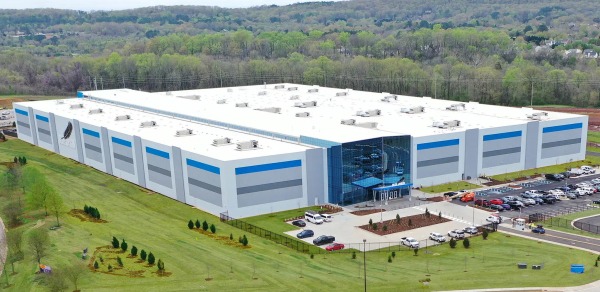
Blue Origin plant in Huntsville. Photo: Blue Origin
Helderman said the agreement and being on Redstone with access to its machine shops has proven beneficial for the company.
“It’s worked out really well for us,” he said. “It doesn’t make sense to set up a machine shop. Our turnaround time is one hour … we’re able to do that through our demand services agreement.
“Being on Redstone helps speed up things.”
Case said Marshall is using the model and experience to expand and recruit more companies.
“We just closed on greenspace for other companies,” he said. “This is a model we want to employ with other companies.”
The city also helped draw Blue Origin with some $200,000 in hiring incentives and up to $200,000 to support related infrastructure improvements as the project meets specified targets.
Now, not only does the company have the factory in Cummings Research Park, it has a dedicated facility for its Blue Ring program in Jetplex Industrial Park.
According to Blue Origin, Blue Ring is an all-in-one, high-powered hybrid solar electric and chemical propelled spacecraft that provides unmatched mission maneuverability, versatility, and capacity at lower profile costs.
And, the business model is paying off more dividends for Blue Origin, Marshall and the area. The company’s Mars Telecommunications Orbiter, built upon the Blue Ring platform, is in production at the plant.
“The plan started as an engine plant with 200 people and 50 people at the test stand,” Helderman said. “Now, we have 2,000 people in Huntsville.”