

HudsonAlpha Institute for Biotechnology highlights breakthrough research in diabetes, Huntington’s disease
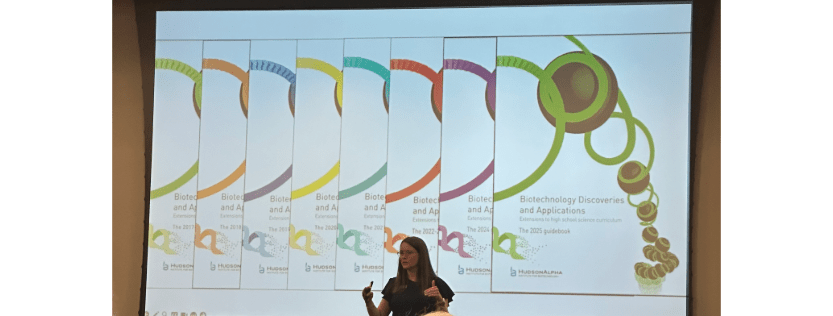
The HudsonAlpha Institute for Biotechnology recently hosted its “Recent Genomics and Biotech Discoveries” event. At the presentation on Feb. 24 at the Jackson Center, attendees heard about groundbreaking discoveries in human health and agriculture.
HudsonAlpha Vice President for Educational Outreach Kelly East and Madeline Loftin, the institute’s director of educator professional learning, walked the crowd through multiple scientific breakthroughs featured in the organization’s 2026 Guidebook for educators.
The stories shared were:
- Ancient DNA and the origins of disease
- A “stealth” strategy for Type 1 Diabetes
- Huntington’s disease treatment
- Solutions for animal and plant viruses
- Chewing gum test for Influenza
- Newly discovered cellular organelle
- Hair Loss Treatment
While the new discoveries were talked about with excitement, East wanted to emphasize that many of these scientific projects are still in the early stages of development and testing.
“We love to tell you these stories about incredible things that we’re learning, but you have to stay curious. Sometimes things that look really promising don’t pan out,” East said.
Ancient DNA and the Origins of Disease
In the first story shared by East, scientists analyzed DNA from over 1,300 ancient human remains to study the history of pathogens, a field known as paleoepidemiology. They found that the bacteria causing the bubonic plague, Yersinia pestis, were far more widespread thousands of years earlier than previously understood.
Type 1 Diabetes Treatment
Loftin spoke about a breakthrough focused on a new potential treatment for type 1 diabetes that involved genetically altering donor islet cells to make them “stealthy” to the immune system. When transplanted into a patient’s forearm, these cells produced insulin without requiring the patient to take immunosuppressant drugs.
“If eyelet cell transplants can be helpful for those individuals with type one diabetes, in particular those who have poorly controlled diabetes, this could be a game changer. But we should not jump straight to the word cure,” Loftin said.
A Gene Therapy Approach to Huntington’s Disease
East spoke about a small-scale clinical trial for a new Huntington’s disease drug, AMT-130, which showed significant promise. The treatment, which involved a one-time injection into the brain, delivered a recipe for a microRNA that reduced the toxic levels of the Huntington protein.
In the trial, treated patients experienced 75-80% less disease progression than untreated patients.
“Now, that’s not zero progression. There was still progression, but noticeably less for a disease for which there are not good treatments out there today,” East said.
Promising Hair Regrowth Treatment
In the last story shared by East, a small molecule named PP405 was shown in Phase 2 clinical trials to effectively “wake up” dormant hair follicle stem cells and stimulate the growth of new, longer hair, offering a potential new treatment for baldness.
According to East, the small molecule, through a topical treatment, “… targets a protein that is in those hair follicle stem cells and adding this small molecule essentially wakes them up, it turns them on, it tells them to send the signals to grow hair.”
“It is not peach fuzz that is growing; it is longer type hair that is being stimulated and grown,” East said.
Additional stories highlighted at the event included:
- New Ways to Fight Viruses in Animal and Plant Agriculture: CRISPR gene-editing technology was used to alter a protein in pigs, making them resistant to the porcine reproductive and respiratory virus. Researchers at HudsonAlpha also identified two new genes that are resistant to the tomato spotted wilt virus in peanut plants, enabling more efficient, rapid breeding of resilient crops.
- Chewing Gum Test for Influenza: A taste-based sensor was developed to detect the presence of an enzyme produced by the influenza virus. The technology could be incorporated into chewing gum or a lollipop to provide a fast, simple, and cost-effective method for flu screening.
- Newly Discovered Cellular Organelle: Discovered within an algae cell, the“nitroplast” can fix nitrogen, a function previously believed to be exclusive to certain bacteria. Its discovery could have major implications for agriculture.
These scientific discoveries and others will be available in the HudsonAlpha 2026 Guidebook, which will be released later this March.