
Cummings Aerospace’s Hellhound combines affordability, utility and lethality
“We’re really trying to give maximum utility to the soldier at a price that is highly affordable.”
That’s how Sheila Cummings, CEO of Cummings Aerospace, describes her company’s latest product for American and allied soldiers – the Hellhound S3.
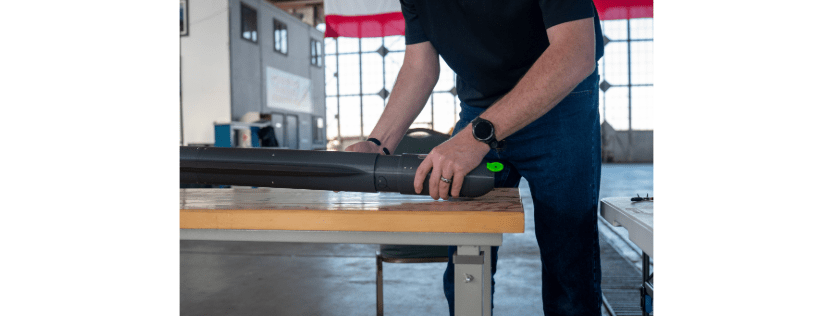
The Hellhound S3 drone is 3D-printed at the company’s 46,000 square-foot facility at Redstone Gateway.
“We’re keeping it local,” Cummings said this week at the AUSA Global Force Symposium & Exhibition.
A Native American Woman-Owned Small Business headquartered in Huntsville, Cummings Aerospace is an aerospace engineering company delivering weapon system solutions for defense modernization and readiness.
The company’s expertise encompasses the design, development, production, and sustainment of missile systems, hypersonic vehicles, radars, command and control systems, and associated technologies.
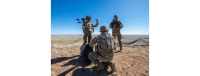
The S3 is a lightweight, vertically launched, man-portable kamikaze drone. It is made using commercially available 3D printers in-house and buying commercially available standard parts that are not unique to just a few suppliers, Cummings said.
“If you think about low-cost solutions — that’s part of the strategy — we have to design something that we can get screws from multiple vendors, we can get 3D print material from multiple vendors,” she said. “We talk about exquisite payloads, that’s a different challenge, but electronics, we have to make sure we can source them from multiple vendors.
“3D printing: One – creates a technological advantage; and two – can rapidly produce prototypes. We really maximize the technology.”
Hellhound also offers something unique among its competitors: an interchangeable, twist-and-lock nose that gives the soldier the ability to meet the ever-evolving complexity of the battlespace by switching between a warhead; electronic warfare; or Intelligence, Surveillance and Reconnaissance (ISR) payload.
The system fits into a launch canister that doubles as the drone’s carrying case. Using the twist-lock system, the nose section takes less than 10 seconds to change out, and it makes the vehicle smaller and easier to carry when removed. The payload weighs from 1 to 4 pounds and the whole system is about 12 to 14 pounds.
“With the modular architecture, we can interchange payloads,” Cummings said. “It’s easy changing the payload.”
The S3 is turbojet-powered and has been clocked at more than 380 mph. And the S3 has been accurate in distance testing.
“A solo soldier can hit a target 60km away,” Cummings said. “Recent warhead tests prove the lethality of the system.
“Every piece of testing gives evidence of reliability.”
Building on the S3’s success, Cummings Aerospace is developing a S4 variant to take on air defense missions, particularly countering drone threats,
The S4 is “really a multimission capability as well as a multilaunch platform capability,” Cummings said. “So, ground-based is kind of the primary, but then the airframe and launch canister can support an air- and sea-based launch.”
The S4 is in the engineering development phase and the company is building prototypes. The plan is to go into flight tests this summer, Cummings said.
Meanwhile, like the S3’s vertical launch, there is nowhere to go but up for Cummings Aerospace.
“Cummings Aerospace was built on missile defense programs,” Cummings said.” That’s how we first got started, and so we have, over the last 16 years, contributed to almost every interceptor, sensor or [command-and-control] program within the missile defense portfolio.”