

Huntsville kicks off Historic Preservation Month with focus on indigenous history
“When people think of indigenous people, they think of us in the past tense. Indigenous people are not relics … we’re still here.”
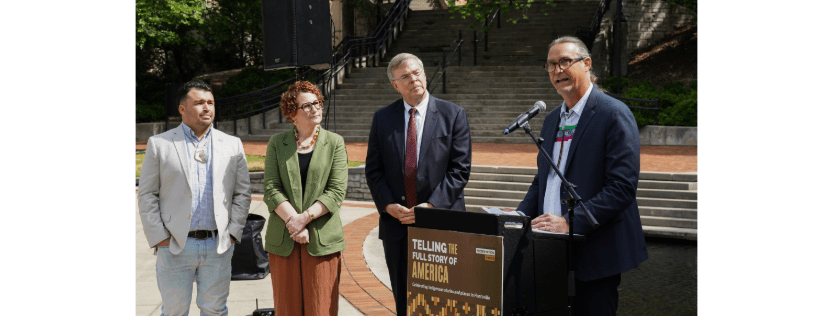
Those words from Brice McGhee of the Poarch Creek Band of Indians accented the theme “Telling the Full Story of America” for this year’s Historic Preservation Month. The celebration focuses on Huntsville’s indigenous history and the culturally significant landscapes that shaped the region long before the city’s founding.
The city kicked off the month-long campaign at a news conference in front of Huntsville’s Big Spring, which has held historic importance and reverence for thousands of years.
“The landscapes we’re highlighting this month have been meaningful for centuries,” Mayor Tommy Battle said. “Historic preservation isn’t about freezing time. It’s about understanding where we come from, honoring those who came before us and making sure these places remain accessible and relevant for future generations.
“When we tell the fuller story, we become a stronger, more connected city.”
Historic Preservation Month is celebrated each May nationwide to raise awareness of the places that tell America’s story.
The celebration is to “recognize and uplift the stories that have not always been told,” said Katie Stamps, the city’s historic preservationist. “It’s to tell an authentic and more complete story of Huntsville.”
This year in Huntsville, the focus is on educating residents about the Indigenous tribes who lived in this region and the continued preservation and investment in culturally significant landscapes such as Monte Sano, Ditto Landing, Big Spring Park, Wade Mountain Greenway and Redstone Arsenal lands.
Huntsville will host events throughout the month including guided walking tours of downtown Huntsville May 7 and May 16 and culminating with a panel discussion May 21: “Telling the Full Story of America: Celebrating Indigenous stories and places in Huntsville.”
For more information and a full list of events, visit the Historic Preservation Month webpage.
“By uplifting Indigenous voices and recognizing these sacred landscapes, we are embracing a more complete understanding of our history — one that respects the people who were here long before Huntsville was established,” Stamps said. “This month is about learning together, listening deeply and celebrating the stories that give meaning to these places.”
The news conference was held in Big Spring Park East, at the base of Big Spring, where settlers established Huntsville.
“Osiyo,” said Patrick Penn of the Cherokee Tribe of Northeast Alabama, using the Cherokee word for “greetings.”
Penn said the Cherokee also called the site “big spring,” and lived in the area for thousands of years.
“This was among our most sacred places – a place of water,” said Penn. “My people, along with the Chickasaw, called this ‘the big spring.’”
Using the Cherokee word “tohi,” Penn said the big spring and similar waters represented the connection of humans in the natural world with a physical, mental, emotional and spiritual well-being.
Though the Cherokee ceded the land in 1805-06, they were removed from the area through the Indian Removal Act, signed into law by President Andrew Jackson on May 28, 1830. The law authorized the federal government to forcibly relocate Native American tribes from the southeastern U.S. to land west of the Mississippi River, specifically present-day Oklahoma.
Its purpose was to free up land for white settlers and reduce conflicts, leading to the forced removal of over 60,000 people and the devastating 1838 “Trail of Tears,” which caused thousands of deaths.
“By the grace of God, I am here,” said Penn, the pastor of the Dwelling Place. “I am living in this ancient homeland and going to the water. I’m not only praying for myself and my family, I’m praying for all of Huntsville.
“Big Spring belongs to all of us … it is our spring.”
McGhee echoed the importance of preservation.
“Preservation is not about what we save, but how and why we save it,” he said. “Preservation is not only about honoring the past, but shaping the future.
“Muto (thank you).”