
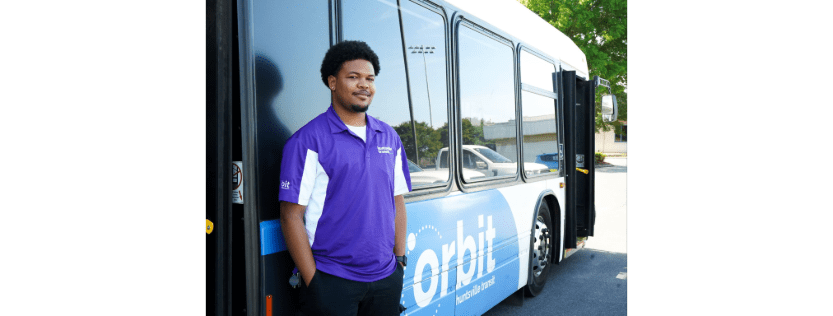

Summit addresses area’s transit needs: ‘Public transit will work’
“If you can make it safe and convenient and attractive, people will use it.”
It doesn’t have quite the international impact of “if you build it, he will come,” but the local impact will be immeasurable.
The statement from John Autry, Huntsville’s manager of public transportation, counters the claims that public transit won’t work here because of people’s love of their cars.
“I don’t think it’s about the culture,” he said. “It has to do with the conditions that are set up – can it get you from A to B in a short amount of time?”
Autry was on a panel discussing public transportation during the recent Launch Transportation Summit. He was joined by Cathy Miller, community impact director with the local United Way; Falguni Patel, the director of transportation at the North Central Alabama Regional Council of Governments; and James Vandiver of the city’s Metropolitan Planning Organization.
As North Alabama continues to grow, so does the need for connected transportation options that move people efficiently between communities, employment centers, healthcare, education, and other destinations across the region.
Autry provided a couple of examples where public transit has been successful in Huntsville.
During the recent Earth Day celebration at Hays Nature Preserve, the city set up a Park-N-Ride at the Mark Russell Recreation Center.
“We packed the buses all day long,” Autry said. “It was convenient, the frequency was every five minutes. We had a Park-N-Ride shuttle for the SMD Symposium … we had several hundred people use it.”
“Public transit will work in the South.”
The panel also discussed the Bus Rapid Transit program, light rail, passenger rail, microtransit and the United Way’s Ride United program.
The city received an $850,000 federal planning grant from the Federal Transit Administration to study land use and housing along a potential Bus Rapid Transit corridor.
The University-Medical Transit Oriented Development Planning Study will focus on three clusters along University Drive as the primary focus for quality, transit-supportive development: the Northwoods neighborhood, the University of Alabama in Huntsville’s former Executive Plaza property, and MidCity District.
The clusters present unique opportunities for residential development, including housing for essential workers, students and families.
The study will also examine a variety of affordable housing policies for different needs and conceptualize designs of station areas and first/last mile connections to visualize how TOD might appear along the corridor and link to nearby areas.
“We’ve engaged with the community and Huntsville Housing Authority,” Vandiver said. “If a bus comes along every 15 minutes or so, it’s a perfect timetable.
“It’s a great opportunity to get in front of this before BRT is built.”
Miller called the Ride United program “gap-filling” in emphasizing that public transportation is essential to workforce development.
“We are doorway to doorway,” she said. “85% of our clients are workforce related: 25,000 people in Huntsville don’t have transportation.”
Patel echoed Miller on workforce needs.
“Transit is an economic tool,” she said. “People that ride NARCOG are going to work; we take them to trainings, to Calhoun.”
But, she said, the Decatur/Morgan County-based program has its limits.
“We have people in Morgan County who want us to take them to east Limestone County (for work), but we can’t take them,” Patel said. “We need to find a solution to cross that border.
“People and their jobs don’t stop at boundaries.”
To answer the need for public transportation in rural areas, Autry mentioned the microtransit concept.
“Microtransit serves low density areas,” he said. “Uber, Lyft, Via provide the services – three-passenger trips per vehicle hour.
“It doesn’t provide bus ridership numbers but it serves a need.”
While Vandiver said there is no chance for light rail to serve the area (“we don’t have the density or the budget”), Autry said passenger rail is being studied.
“We’re working on getting into the statewide rail plan,” he said. “This is Amtrak service between big cities.
“We are looking at how many trips … where passenger rail might make sense in the future.”
There is no rail service for North Alabama. The closest route is from Atlanta through Anniston to Birmingham and south.
“Huntsville to Birmingham is the corridor to look at first,” Autry said. “Huntsville to the Shoals may take a route.
“This could be huge for Huntsville and all of North Alabama.”
Autry said the Federal Railroad Administration provides funding for corridor development, including 100% for an initial study.
Addressing expansion plans for Huntsville’s transit system in the northern and western parts of Huntsville, Autry said his department – like others – faces a staffing problem.
“We don’t have the staff – CDL or non-CDL,” he said. “We have systems ready to go but we lose as many (employees) as we gain. No one wants to work second-shift or weekends.
“We need all the help we can get.”