


Walking tour puts Huntsville’s Reconstruction history at your fingertips
As we recognize the contributions of Black Huntsvillians to the city’s history and celebrate the 250th anniversary of the nation’s founding, the Historic Huntsville Foundation is offering an opportunity to take a walk through history.
“Cornerstones of Freedom: A Walking Tour of Huntsville’s Reconstruction History” brings to life the stories of those whose leadership shaped the community.
Visitors are reminded of the 4 million formerly enslaved men, women, and children whose exercise of their freedoms brought a war-torn nation closer to a more perfect union.
This self-guided tour introduces visitors to Huntsville’s Black leaders who put these principles into action. The 10-stop tour around downtown Huntsville, including the Courthouse Square, can be explored in about an hour.
Among the stops, the tour includes sites associated with Harrison and Daniel Brandon, whose firm provided the masonry for some of Huntsville’s historic buildings; high school principal, city alderman and newspaper publisher Henry Binford, who pioneered the city’s Black suffrage movement.
After the 1901 Alabama Constitution disenfranchised Black voters, Daniel Brandon and Binford were the last Black men to hold city office in Huntsville until 1988 when Dr. Richard Showers Jr. was elected.
“Their stories stand in plain sight,” said Historic Huntsville Foundation Executive Director Donna Castellano, “After emancipation, Huntsville’s Black community organized around education, entrepreneurship, and political equality. Our tour introduces you to the people who put those principles into action.”
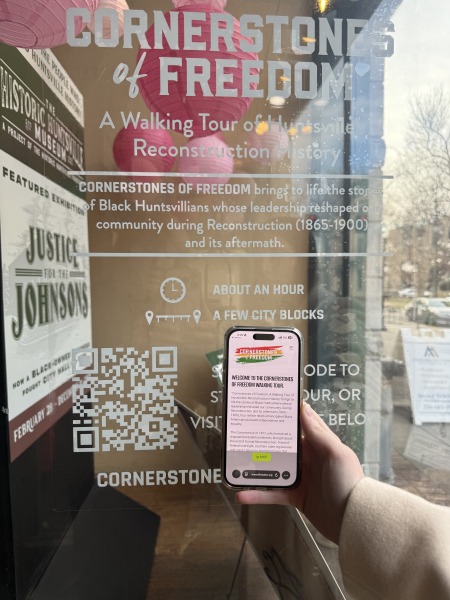
To take the first step of this educational stroll, just scan the QR code on the Harrison Brothers Hardware window and tap the link. Photo: Historic Huntsville Foundation.
Following the Civil War, amendments to the U.S. Constitution guaranteed rights to former slaves.
- The Thirteenth Amendment, ratified in 1865, abolished slavery.
- The Fourteenth Amendment, ratified in 1868, granted citizenship to freed people and their descendants.
- The Fifteenth Amendment, ratified in 1870, provided voting rights to male citizens, regardless of race.
Unfortunately, in the following decades and due to hurt feelings from losing the Civil War southern legislatures and courts began to implement laws that codified legal discrimination.
But, Huntsville’s Black leaders wouldn’t knuckle under and rallied around education, entrepreneurship, and political equality.
Fittingly, the tour begins at Harrison Brothers Hardware on the Square.
Harrison Brandon, the father of Daniel, was the embodiment of Black entrepreneurship after the shackles of slavery were removed. He and his son formed the Henderson Brandon & Son masonry business in 1886 and constructed 11 buildings in downtown Huntsville – four are still standing – from 1886-1902.
The Harrison Brothers building is the best preserved building constructed by Daniel Brandon.
Also on the route are the original site of Alabama A&M University, founded by William Hooper Councill at the corner of Clinton Avenue and Monroe Street; and the site of Huntsville Utilities on Spragins Street, where the Brandons built Alabama’s first public water system at Big Spring.
To take the first step of this educational stroll through the roots of Huntsville history, just scan the QR code on the Harrison Brothers Hardware window and tap the link. It doesn’t require an app.
This opens the route which follows public sidewalks for about 30 to 45 minutes, depending on how long you pause at each stop.
The content is mobile-friendly and can also be accessed at cornerstonesoffreedom.org.