
Dr. Andy Aldrin: Space commercialization riding waves with the occasional wipeout
“Catch a wave and you’re sitting on top of the world,” the Beach Boys sang.
And, according to Dr. Andy Aldrin, waves are the perfect metaphor for the commercialization of space.
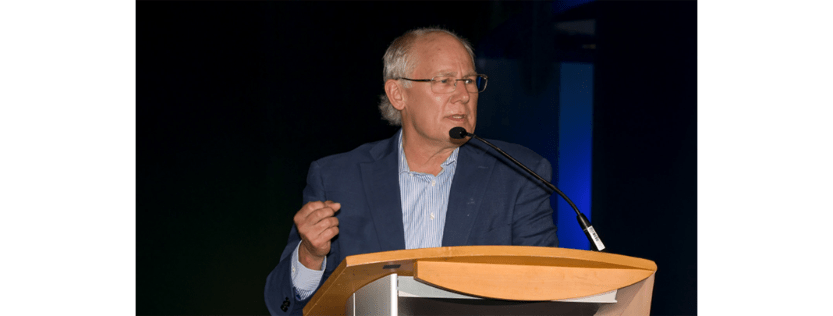
Aldrin, son of astronaut Buzz Aldrin, is the executive director of Space Programs, Embry-Riddle Aeronautical University Worldwide. He was the keynote speaker Tuesday at the Business of Space Conference hosted by the UAH College of Business.
“Rocket fuel is not kerosene,” he said. “It’s cash.”
Referencing the wave analogy, Aldrin said space commercialization arrived in waves with two of them failing to break.
Aldrin’s discussion challenged conventional wisdom by examining why earlier efforts – the first and second waves – to commercialize space faltered and what makes this moment fundamentally different.
He provided a sharp focus on the institutional forces, policy, governance, and market design that will determine whether this third wave reshapes the space economy or breaks like the last two.
“Waves are cyclical,” Aldrin said. “This is not the first wave.”
The first wave, he said, launched with the Space Shuttle in the 1980s and promised transformation but never truly took hold.
“I told my dad, ‘a great idea at a bad time is still bad business,’” he said. “The shuttle is an incredible vehicle; we did incredible things with it.
“But, it was too expensive.”
The wave crashed with the Challenger explosion 40 years ago – Jan. 28, 1986.
“That was a tragic event for all of us,” he said. “And it was especially felt here at the Marshall Space Flight Center.”
The second wave, 1995-2002, crashed under its own weight and Aldrin appropriately noted it was a “wipeout.”
“Launch companies went bankrupt or reorganized,” he said. “It was not a fun time to be a space cadet.”
However, on the horizon was another wave rolling in – the coming of Blue Origin and SpaceX, true commercial space companies.
Today, the commercialization of space is catching that third wave and it may be the most disruptive yet, Aldrin said.
“I don’t know if we’re going to get wiped out or ride it,” Aldrin said of this wave. “SpaceX isn’t going to go bankrupt. It may deflate, investors may lose money.
”I don’t think it’s that much of a risk, but it is a risk.”
Aldrin cited examples of space investments that can catch the wave to success or wipe out.
- Orbital Mobility – Basically investing in orbiting “fuel depots” at $2 billion to $4 billion a launch.
“It’s a market. NRO (National Reconnaissance Office) is a very wealthy customer. If you can refuel those satellites, you can make money.” - Telecommunications – A bit of data doesn’t care how it gets there. However, he warns that global communications’ revenue is flat.
“The fixed data market is shrinking because as cellular (options) creep out, people move to cellular from broadband. They have to learn the details.
“This is where the engineers and business people have to get together … it’s hard to do this stuff.” - Earth observation market – The perfect wave, he said, due to the insurance and finance industries needing to transmit their data.
“The key is connecting users. The consultants will make this market move.”
“Space is the trillion-dollar economy,” he said.