
North Alabama Commission Chairmen discuss growth, infrastructure, workforce development at Madison Chamber event
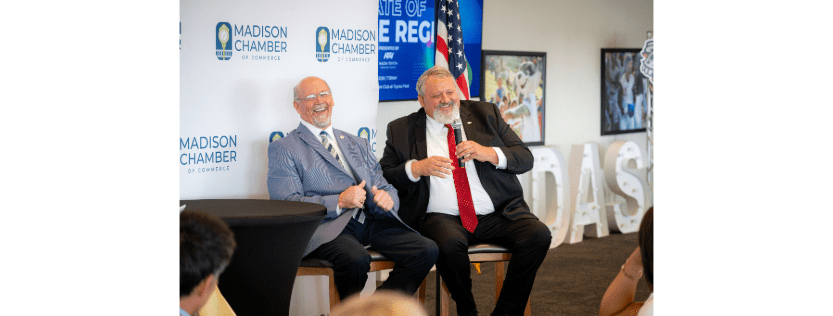
The Madison Chamber of Commerce hosted its first State of the Region event Tuesday, July 28, at Toyota Field, bringing together elected officials, business leaders and community partners to discuss the opportunities and challenges facing Alabama’s fastest-growing region.
The highlight of the event, a panel discussion, featured Madison County Commission Chairman Ronald “Rex” Vaughn and Limestone County Commission Chairman Collin Daly.
Moderated by Whitney West Elliott, director of development for EarlyWorks Children’s Museum, the conversation focused on transportation infrastructure, workforce development, education, regional collaboration and preparing for continued growth.
Opening the talk between the chairmen, Elliott asked Vaughn how local governments are responding to increased traffic and infrastructure demands created by rapid population growth.
Vaughn noted Madison County has added approximately 132,000 residents over the past two decades while continuing to rely on many two-lane roads that were never designed for today’s traffic volumes. He also pointed to the nearly 77,000 commuters who travel into the region each day for work, placing additional strain on major corridors.
Despite those challenges, Vaughn said cooperation between local, state and federal officials has been key.
“They continue to fight for Madison County, Limestone County, and our corridor up here for road dollars. It’s just an equation that’s hard to figure out. But considering all that, I think it is monumental that we always have a multi-jurisdictional approach in trying to fund our road issues,” Vaughn said.
He acknowledged funding often arrives at unpredictable times but said local governments remain committed to addressing transportation needs as resources become available.
Vaughn continued, “Funding comes in at odd times, sometimes, maybe not ideal, but that is our goal is to meet the challenges as we can with what funds we have.”
Continuing the conversation, Elliott asked Daly how he balances the educational needs of current and new residents.
Daly highlighted Limestone County Schools’ career technical education program, pointing to partnerships with employers such as Mazda Toyota Manufacturing as an example of preparing students for careers before graduation.
He said the region’s long-term workforce strategy begins with educating local students and giving them reasons to build careers close to home.
“Workforce development is a big issue in this area. The only way we’re going to get a workforce is to raise it. We try to create not only the education side of it, but also a reason for the children to stay here when they graduate,” Daly said.
Vaughn added that North Alabama’s educational institutions play a significant role in supporting the region’s workforce pipeline. He also highlighted recent investments in technical and healthcare training programs designed to meet employers’ evolving needs.
As development continues across both counties, Daly said balancing the needs of rapidly growing urban areas with more rural communities remains one of Limestone County’s greatest challenges.
He noted that residents often have different expectations depending on where they live, but said collaboration remains the county’s greatest strength.
“We can all get along, and we can work together,” Daly said.
When asked what success looks like by 2035, Vaughn emphasized protecting the qualities that have made North Alabama attractive to residents and businesses.
He also said that while Madison and Limestone counties continue to gain residents, much of Alabama is experiencing population decline.
“Across Alabama, some of you may not realize, but of our 67 counties, 47 of our counties are losing population every year,” Vaughn said.
Vaughn continued, “That’s because there are no job opportunities. There’s nothing to keep a family intact there. They look for ways to get out of that county. So only 20 of our counties are actually gaining population,” Vaughn said.
Vaughn said maintaining strong public safety, quality schools and economic opportunities will be essential as the region continues to expand.
“We have to make sure that we are prioritizing what we’re already doing, continue to do it well and do it right,” Vaughn said.
Daly predicted North Alabama’s population will continue climbing over the next decade, driven by growth at Redstone Arsenal and continued economic development throughout the region.
“In 2035, I look for us to have a lot more people. But not only that, we’re going to have a lot more things to do,” Daly said.
As the discussion concluded, Vaughn reflected on another aspect of the region that has stood out during his time as commission chairman: the strength of North Alabama’s nonprofit community.
“I continue to be amazed at the generosity that our companies, that our community provides for these nonprofits. I think it goes back to the kind of people we have here in North Alabama,” Vaughn said.