

Huntsville Utilities explains spike in winter bills, citing cold weather, system demand and TVA costs
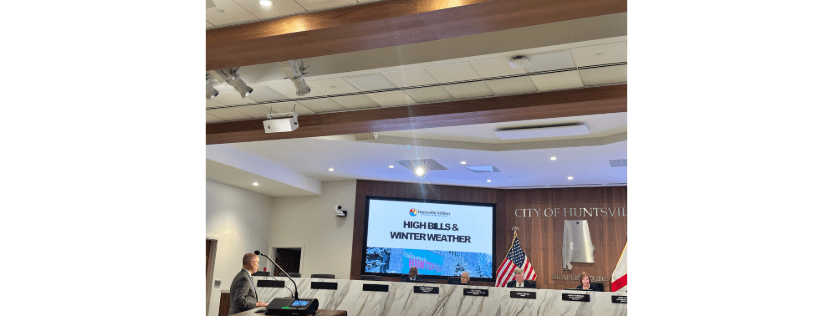
Rising winter utility bills drew concerned residents to a Huntsville City Council meeting on Thursday, March 26. During a scheduled presentation that evening, Huntsville Utilities CEO Wes Kelley outlined the factors behind the increase that has caused significant public concern.
At the meeting on Thursday, March 26, Kelley stated that in January and February, the utility company’s customer service team received nearly 46,000 calls. More than 5,600 people came to discuss their bill in person.
According to Kelley, around 4,000 calls came in from commercial business customers.
“About a quarter of our customers contacted us in January and February,” he said.
Kelly continued, “Every month we send a bill, and sometimes that could be one of the most difficult things that a customer experiences, especially during the period of high use and extreme weather like we’ve had of late.”
Kelley said he understood the responsibility Huntsville Utilities has to provide this information and to build trust.
In his hour-long presentation to the city council and Madison County residents who were present during the meeting, Kelley said he wanted to be sure residents understood the rates and what drives them.
“Hold us to account to make sure that we are providing the information and the resources as is appropriate to the citizens and the community that we serve,” Kelley said.
Kelley attributed the high costs primarily to an extended period of cold weather that forced inefficient auxiliary heat systems to run excessively.
“Forty degrees is a pretty important threshold in our business because once the temperature drops below 40 degrees and you have an electric heat pump, that heat pump starts to significantly become less efficient, and it pulls in other heating sources to warm your home,” he said.
Kelley explained how colder temperatures directly impact Huntsville Utilities’ overall energy usage.
“There’s usually a pretty good, tight correlation between the lower the temperature, the higher the energy usage and the higher the amount of electrons that flow through the Huntsville utility system,” he said.
Kelley explained that TVA bills Huntsville Utilities for the energy delivered into Huntsville and pushed through the utility system. TVA meters Huntsville Utilities at 14 locations around the county.
“TVA has their meters at those locations and they bill us on an energy and demand basis, just like we bill our customers. TVA will insist that we pay them for the energy that we bought from them. Whether or not we collect that money from the customer is not TVA’s concern,” Kelley said.
During his presentation, Kelley showed a sample bill from a customer and stated that during the winter billing period, approximately 17% of the revenue stayed with Huntsville Utilities and 83% of the revenue went to TVA.
He assured the council that multiple external audits were underway to verify the accuracy of their new billing systems and detailed the extensive financial assistance programs available to customers.
“Most importantly, how do we respond? First off, we got to make sure our numbers are right. We got to take this seriously. I take this very seriously,” Kelley said.
Kelley said financial assistance programs and community partnerships have provided significant relief to customers facing high bills.
“That’s a million dollars worth of support that has come in to help customers during this critical payment period,” he said.
Following the presentation, Huntsville City Council President Pro Tem Bill Kling encouraged Huntsville Utilities to expand its public outreach efforts.
“If you could somehow use the people that you have just to get a general public information campaign out, you could do a press conference,” Kling said.
Kelley agreed additional communication would be beneficial.
“We have had very strong community outreach on that in the past, but it’s been a while and we need to redouble our efforts there,” Kelley responded.
Kelley’s presentation and dialogue with city council members offered a clearer look at what’s driving higher bills during colder months. Following the presentation, the CEO and his team remained available to meet with residents one-on-one to discuss specific billing concerns.